A CASE STUDY OF SAN FRANCISCO
FEBRUARY 2026
For years we’ve discussed a central force shaping the housing market: there simply aren’t enough homes. Despite subdued demand in many markets, prices remain elevated largely because there’s little incentive for existing owners to trade in the cheap mortgage rates available before inflation revved up in 2021. As noted in our October 2025 Spotlight, roughly one-fifth of outstanding residential mortgages carry interest rates below 3%, and 81% of mortgages have interest rates of 6% or lower.
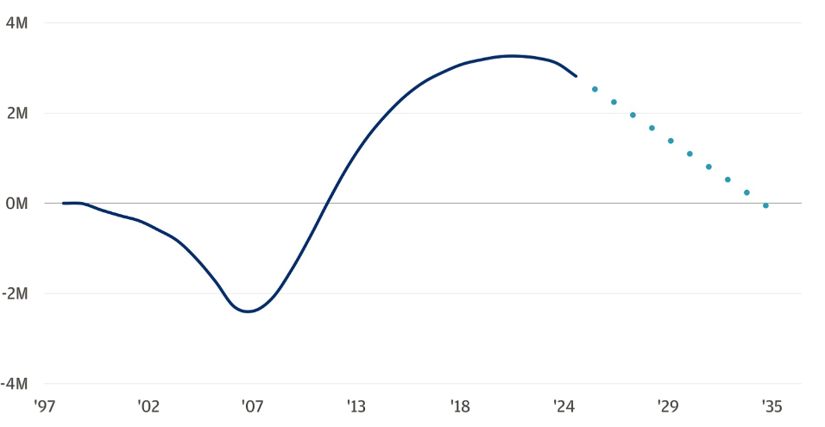
The only way to combat the supply shortage is to build more housing. According to a JP Morgan Private Bank estimate, the current national housing shortage is approximately 2.8 million units which could take a decade to resolve. Much of the housing shortage is concentrated in coastal and urban cities rather than rural or middle America. The last time housing supply met demand was well over a decade ago. And yet, homebuilders across many markets are struggling to move inventory. Last summer, new home inventory hit a 16-year high with 121,000 unsold homes—a level not seen since the aftermath of the Great Recession.
Cumulative housing shortage and trendline, millions of units
If the country needs more housing, why are new homes sitting? And why, in many markets, are resale homes selling but brand new ones not?
In order to try and understand, we turn to San Francisco as a case study. While the city isn’t representative of the entire country, it serves as an interesting barometer because of the long-running structural undersupply of housing, relatively high household incomes, and its position as a hub for the new AI tech boom.
San Francisco’s housing landscape comprises single-family homes and smaller multi-unit buildings in mature neighborhoods such as Pacific Heights and Hayes Valley as well as a series of new construction condominiums concentrated in neighborhoods such as SOMA and South Beach. While the former sit within long-established neighborhoods with distinct identities, the latter emerged alongside the city’s tech office corridors and are primarily high-density, vertical, and amenity driven.
Although San Francisco struggled post-pandemic, today, many people are now back in the office (at least in hybrid form) and the city has benefited from the recent AI boom. In December 2025, single-family home sales were up 20% year-over-year. The median sale price rose 10% and the typical home sold 9% above list. Condominium sales were also up 19% year-over-year, with units generally selling at asking prices and the median price was up 6.2%.
Yet if you ask a sales agent at one of the city’s 15+ new construction condominium buildings, they’d likely tell you things are moving, well, slowly. The average new construction absorption rate in 2025 (based on reported contract sales) was less than one unit per month.* The typical San Francisco new construction building has 90 units. At the current pace of absorption, it would take 7.5 years to sell out—far slower than initial projections. So why aren’t new construction homes moving?
The key reason is affordability. What this case study highlights is the issue of relative affordability: new construction is delivered at price points above where most buyers are transacting in the resale market.
The two charts below detail San Francisco resale condominium transactions in 2025 versus inferred sponsor condominium inventory by price cohort.
Sponsor inventory is estimated based on the number of reported units remaining at key new-construction developments multiplied by the average sale price of units that closed within each of those buildings in 2025. While this methodology is approximate, it offers a useful directional view of where buyer demand is concentrated versus where new construction supply is being offered.
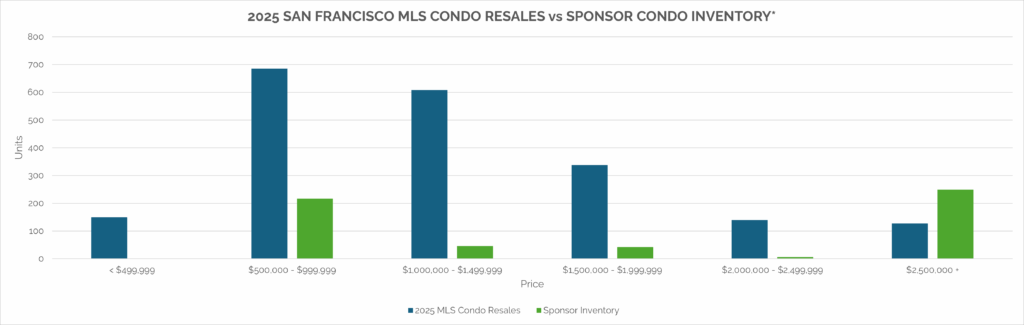
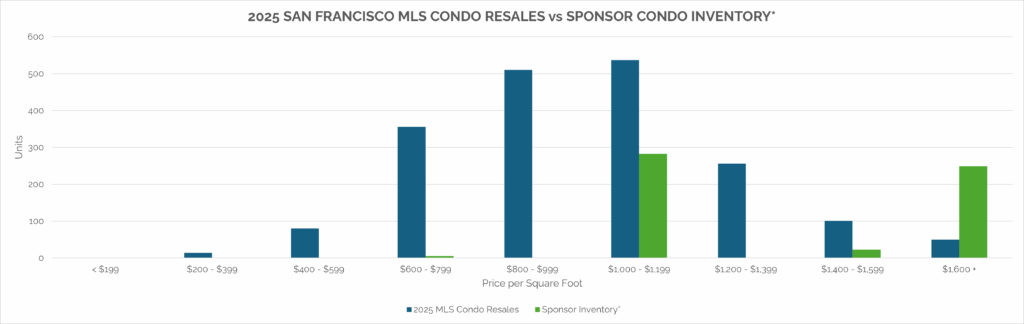
As shown above, a large concentration of new construction homes are priced over $2.5M and $1,600/SF, despite the majority of resale transactions taking place for less.
Note: Broader market data reflects 2025 MLS transactions. Sponsor inventory is derived on reported contract sales at select San Francisco developments with active new-construction supply. Sponsor pricing estimates use average pricing from 2025 closings, and assume all unsold units are valued at the average price of recent transactions within the same project.
*Buildings with 25+ units with actively selling sponsor inventory
Of the new construction homes that are selling, the majority of the ones selling above the city average of 0.9 units/mo in 2025 have an average sale price of under $1.5M
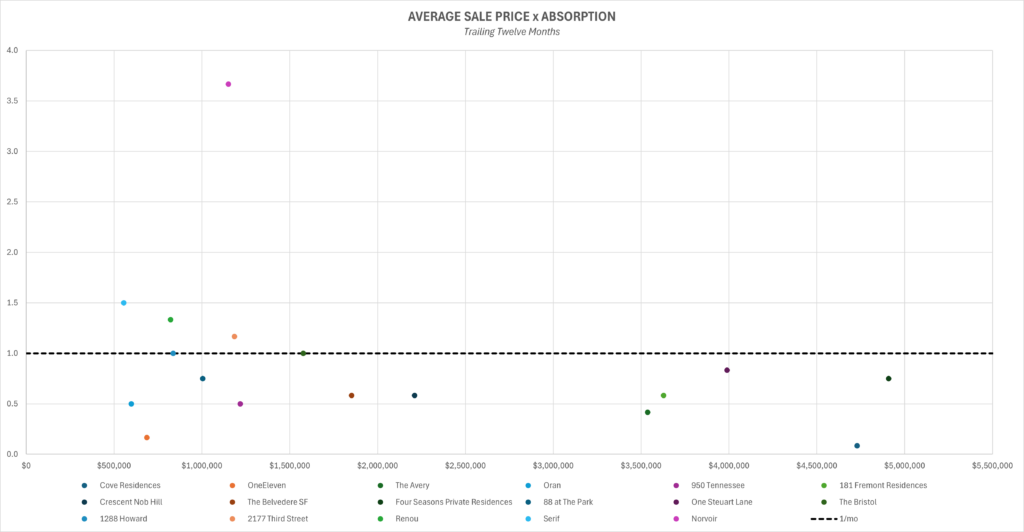
This suggests that the new construction developments that are selling relatively well are those offering more favorably priced units.
To understand why this matters, it’s useful to view these price bands in the context of a typical high-earning buyer in San Francisco. AI Engineering is one of the most lucrative careers at the moment. According to Glassdoor, the median AI engineer in San Francisco earns $213,000 per year. Assuming a dual-income household making $500,000 annually (which assumes two above average AI engineers in the same household), what can they reasonably afford?
Using Freddie Mac’s home-buying calculator and assuming no existing monthly debt, with a $500,000 down payment, and a 30-year fixed mortgage at 6%, this household could afford a home priced up to approximately $2.385 million, with a total monthly payment of $11,667. This is a healthy budget—well above the December 2025 median sale price for single-family homes ($1.675M) and condominiums ($1.12M), but it does not stretch as far when applied to many of the city’s new-construction developments.
The following three case studies illustrate how the relative affordability of new vs resale translates into currently marketed listings:
1) Entry-level: A one-bedroom at Renou (one of the city’s fastest-selling new developments) versus a similarly sized resale condominium in SOMA.
2) Mid-range: A two-bedroom at The Avery versus a historic four-bedroom condominium in Hayes Valley.
3) Ultra-luxury: A two-bedroom at One Steuart Lane (the city’s premier new development) versus a historic single-family home (2BR) in Pacific Heights.
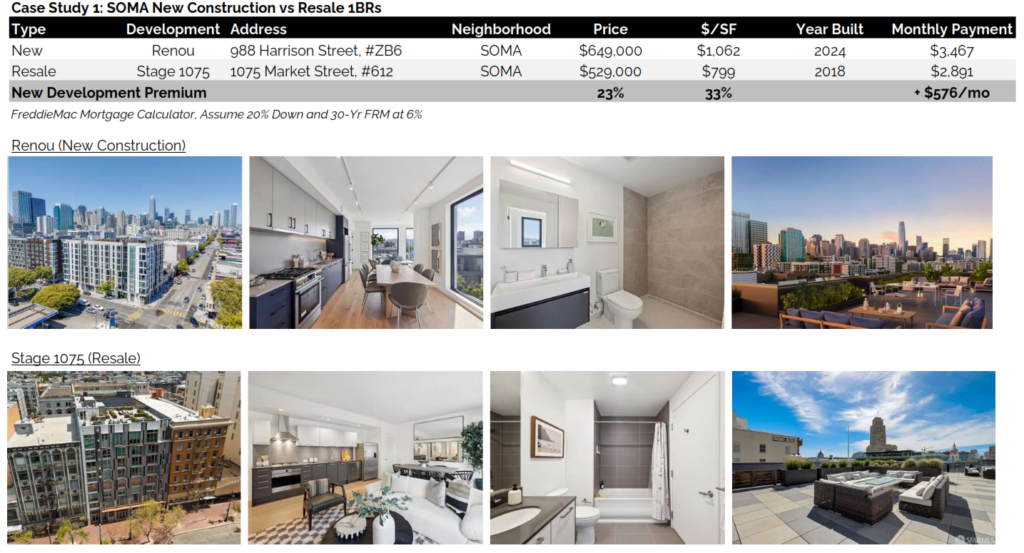
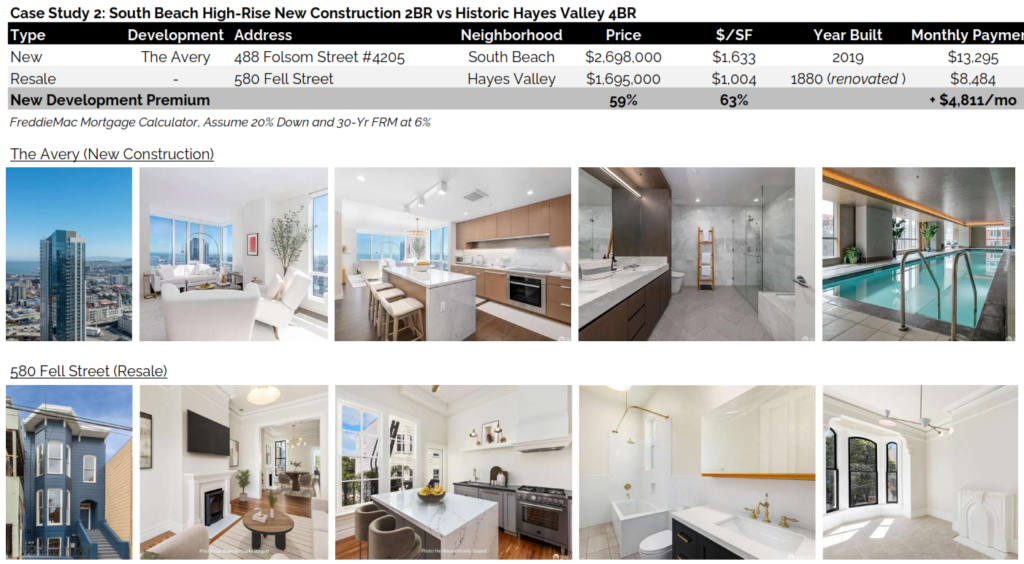
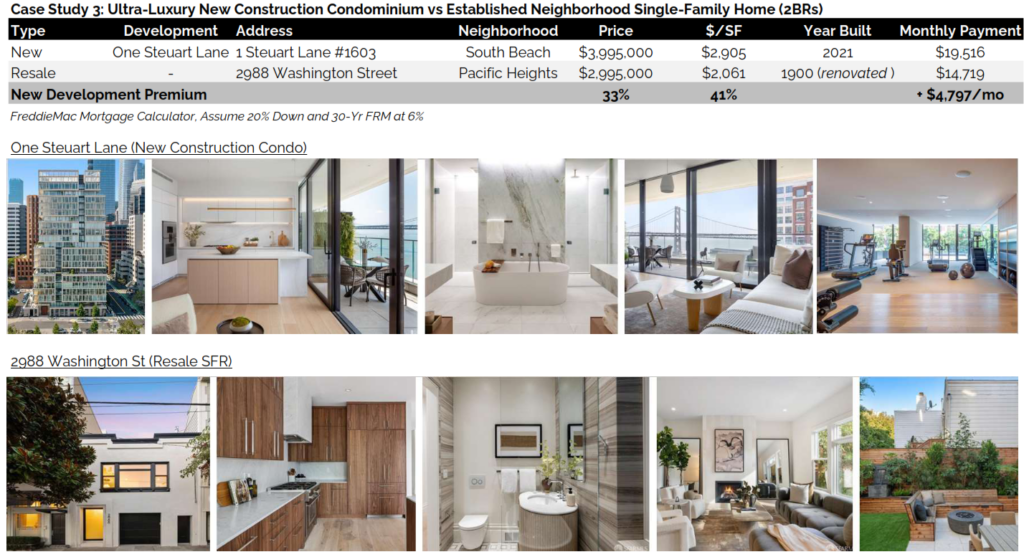
As shown in the three examples, new construction units are priced at significant premiums. That is not surprising in itself—new product virtually always commands a premium over resale—but when those premiums are translated into real monthly payments, the differences become stark. In the mid-range case study, the monthly payment at The Avery would cost nearly $5,000 more per month (or +57%) relative to a renovated four-bedroom condominium in Hayes Valley. For our hypothetical dual-income household, The Avery unit remains out of reach.
Taken together, San Francisco illustrates that the challenge for new construction isn’t always demand in the traditional sense. Buyers are willing to pay for housing, and in this case will pay at or above asking, but they are unwilling (or able) to bridge the large relative premiums between new construction and resales.
So while the housing shortage is real, so is the shortage of affordable housing. For developers, the challenge of delivering new housing in favorable price bands is difficult: post-pandemic construction costs remain high, land and entitlement timelines are lengthy, labor is scarce, and imported home-building materials now face punitive tariffs. Until the cost of building middle-market housing comes down, resales will likely continue to outpace new construction sales in many markets.
Sources
FHFA National Mortgage Database (NMDB)
JP Morgan Private Bank, Haver Analytics. Note: Cumulative housing unit shortages calculated using the difference between housing completions and net household formation.
Trendline calculated by extrapolating yearly trend from 2023-2024.
All information is from sources deemed reliable but no guarantee is made as to its accuracy. All material presented herein is intended for informational purposes only and is subject to human errors, omissions, changes or withdrawals without notice.