
TO SUCCEED, DEVELOPERS SHOULD FOCUS ON EMERGING LUXURY MARKETS, BUILD STRONG BRAND IDENTITIES, AND CREATE A FEELING OF EXCLUSIVITY
August 2025
The concept of branded residential real estate dates back to the 1920s with the opening of The Sherry-Netherland, a 38-story hotel and co-op on New York City’s Fifth Avenue. Since then, branded residential real estate has expanded significantly across the US and internationally. According to a late 2024 report by Savills, there has been an 180% global increase in branded residences over the last decade with 240 projects in 2024 alone.
There are four types of branded residences:
- Condo hotel: hotel-branded residences situated within a hotel, often with a use restriction and mandated rental pool
- Standalone: hotel-branded residences located separate from a hotel site
- Co-located: hotel-branded residences located on the same property, or immediately adjacent to a hotel, but without use restrictions or rental pool
- Non-hotelier: residences associated with a non-hotel brand, such as automotive, fashion, or design brands
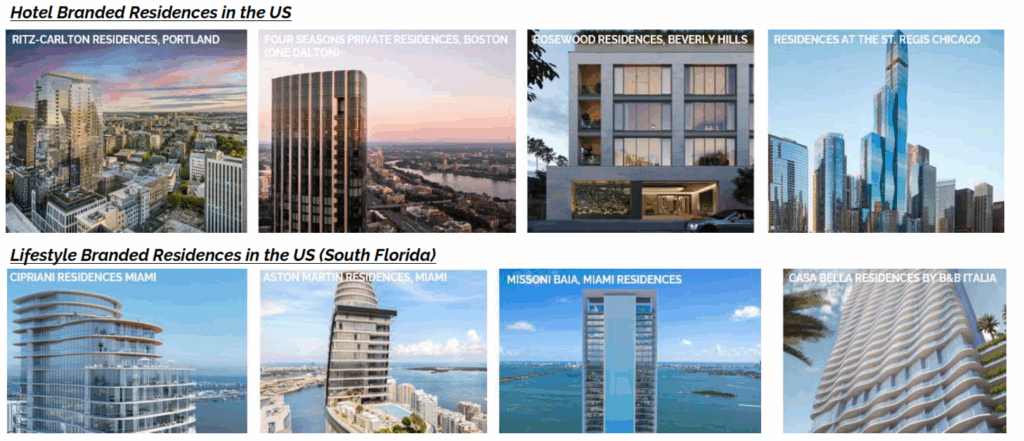
While hotel brands comprise the majority of branded residences, an emerging sector has been lifestyle driven propositions by automotive, design, fashion, and food & beverage brands. Globally, the top five hotel brands with residential projects are The Ritz-Carlton, Four Seasons, St. Regis, Rosewood, and Fairmont. Non-hotel brand leaders include YOO, Pininfarina, Trump, Elie Saab, and Nobu.
Value Proposition for Buyers
For a buyer, branded residences offer a significant value-add, including:
- Prestige associated with a brand
- Design, amenity, and service quality assurance
- Professional and experienced management (“lock and leave”)
- Rental potential
Typical premiums for urban branded residences range from 20% to 30%, while branded resort properties can earn premiums of up to 100% above similar non-branded homes.
Established and Emerging US Markets
In the United States, South Florida is the epicenter for branded residences, including emerging concepts by non-hotel brands. In the last decade, brands such as Porsche, Bentley, Armani, Fendi, Aston-Martin, Cipriani, and Missoni have all launched residential concepts here. Furthermore, the US has seen growing demand for branded residences, particularly hotel brands, in many secondary and tertiary cities such as Atlanta, Houston, Charlotte, and Charleston—a shift from the historical prevalence of these concepts in urban hubs and resort markets. Today, 37 out of 50 states have at least one branded residential project.
Strategies for Success in Branded Residential Real Estate
While branded residential concepts continue to evolve and transform real estate, delivering concepts that align with and embody a clearly defined identity will be key to standing out, especially in more established markets such as New York City, South Florida, and Los Angeles.
Key strategies for success include:
- Understand the target market’s preferences and loyalties: more traditional and less established markets will likely favor hotel brands with established credibility and brand recognition in living and hospitality, whereas more urban and established markets will appreciate creative concepts from lifestyle brands that have a clear identity and differentiate themselves from an otherwise oversaturated luxury housing market
- Provide comprehensive lifestyle services that may not be found in non-branded high-end real estate: high-touch concierge, valet, privatized food & beverage offering (in-home dining, private dining for residences, etc.)
- Exclusivity: offering a limited number of units and creating a feeling of scarcity will elevate the perceived value and drive demand. In the case of condo-hotel or co-located projects, this may manifest as privatized amenities that hotel guests cannot access (even if it means duplicate spaces, such as a pool, fitness center, etc.)
- Offer lock-and-leave solutions, including property maintenance and professional management, to appeal to buyers who seek maximum convenience. In the case of condo-hotel or co-located properties, a flexible rental program will also be attractive to buyers looking for investment potential
Sources:
Payne, Jason. 2024. “37 States in America Have Branded Residences | Branded Homes.” BRESI. Luxury Branded Residences.
Branded Residences. September 14, 2024.
Savills. 2024. “Branded Residences Annual Report.” Savills.com.
All information is from sources deemed reliable but no guarantee is made as to its accuracy. All material presented herein is intended for informational purposes only and is subject to human errors, omissions, changes or withdrawals without notice.