
TRUMP'S LATEST PLAN TO ADDRESS AFFORDABILITY BY RESHAPING THE HOUSING MARKET
DECEMBER 2025
While President Trump ran and won the 2024 Presidential Election on a platform aimed at alleviating the high cost of living for Americans, there has been little progress made. In his latest effort to address affordability, Trump announced a bold plan in November to reshape the housing market by creating a 50-year mortgage.
Unlike in many other countries, long-term, fixed-rate mortgages are the norm in the American housing market. According to the Federal Reserve, “about 40% of US households have mortgages, of which 92% have fixed rates.” The prevalence of America’s 30-Yr FRM is largely a byproduct of government intervention during the Great Depression. As part of the New Deal, the Roosevelt administration established the Home Owners Loan Corporation (HOLC) and Federal Housing Administration (FHA). The HOLC was created to help prevent widespread foreclosures by buying failing mortgages from lenders and issuing new, long-term (& thus lower-interest loans) to struggling homeowners. The FHA was created a year later under the National Housing Act of 1934; its purpose was to provide mortgage insurance to lenders thereby protecting them from losses if a borrower defaults. This made homeownership more accessible, especially for first-time buyers or individuals with low to moderate incomes, or lower credit scores. Together, these organizations helped clear the way for longer term mortgage loans in the US. Eventually, the creation of Fannie Mae (and later Freddie Mac) helped solidify the 30-year mortgage’s place in the US housing market. Without public sector intervention, it’s unlikely that long-term mortgages would have been viable for the financial system.
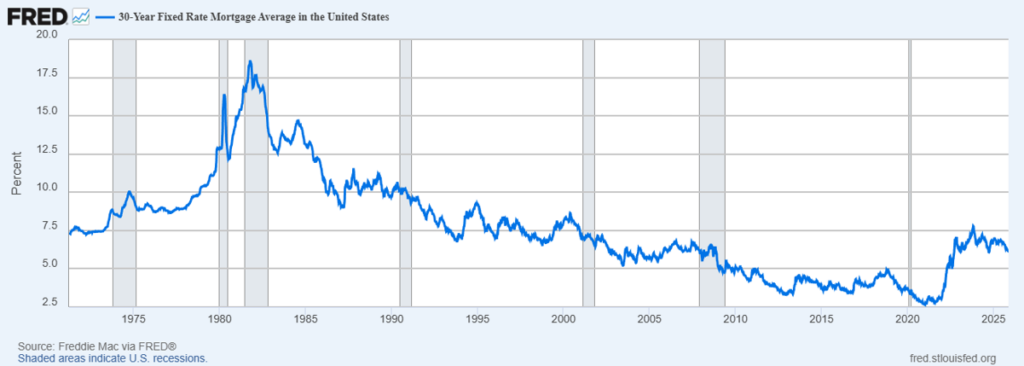
As of mid-November 2025, the 30-year fixed rate mortgage stands at 6.24%. While this is low by historical standards, it’s more than double the prevailing rate during the pandemic. This has resulted in the ‘lock-in effect’ whereby existing homeowners are reluctant to move and give up their exceptionally low rates; depressing existing housing supply and resulting in stubbornly high prices.
Now comes Trump’s plan for a 50-year mortgage with the aim of lowering housing cost by increasing the duration of the loan, resulting in lower monthly payments. In many ways, the idea mirrors the rationale behind existing long-term mortgages, such as the 30-year, which accomplished the same goal post-Depression.
The case for the 50-year mortgage:
•Lower monthly payments: By stretching a loan over 50 years (600 months), monthly payments are reduced, which can make homeownership more accessible for some buyers.
•Increased purchasing power: Lower payments may allow borrowers to qualify for a larger loan amount or a higher-priced home than they could with a shorter-term mortgage.
•Potential short-term flexibility: The average homeowner stays in their home for less than 12 years. Because mortgages are not portable, most borrowers will sell or refinance long before a 50-year term ends. For these homeowners, a 50-year loan could serve as a temporary bridge to homeownership.
The case against the 50-year mortgage:
•Higher total interest paid over the life of a loan: Take for example, the scenario below which assumes the same fixed interest rate over the life of a 30 and 50-year loan. By the end of the loan term, a buyer would pay more than double the loan amount in interest.
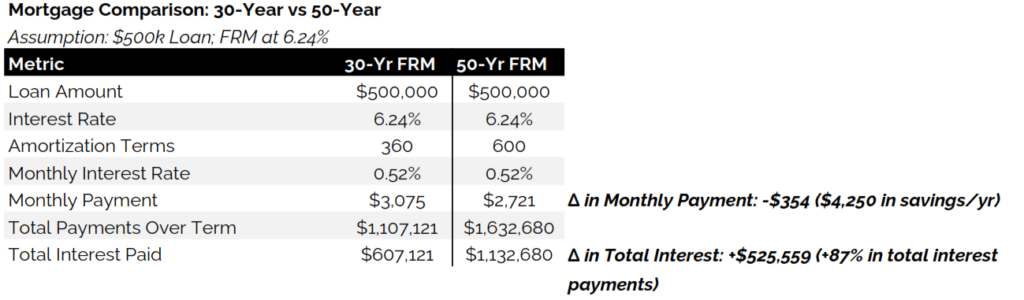
•Slower equity growth: Because interest makes up a larger share of early payments, principal reduction is minimal in the early years. After a decade, a 50-year borrower may have built only a fraction of the equity achieved under a 30-year schedule, which can cause a major gap in wealth building.
•Higher interest rates: Lenders would undoubtedly charge higher interest rates for 50-year loans due to the increased risk of default.
•Long-term debt commitment: According to the National Association of Realtors, the average age of first-time homebuyers in the US is 40 years. With a 50-year loan, some of these buyers could be paying off their home loans in their 90s. Additionally, slower equity growth means homeowners are more vulnerable to market downturns. If the housing market declines and prices plummet, borrowers may find themselves with a large outstanding loan at a fixed rate worth more than the value of their home.
While the 50-year mortgage is an interesting thought exercise, it is not the solution to America’s affordability crisis and housing market woes. Despite the regulatory hurdles it would face, the fundamental problem for housing is supply, or lack thereof. Without solving for this, a 50-year mortgage would just mean lower entry cost and thus more competition and higher prices for an already limited supply of homes on the market. It’s imperative that we find ways to incentivize building more housing. While many states have already made efforts to find solutions—California recently passed the controversial SB79 which is aimed at increasing housing density by allowing developers to build multi-family buildings in areas previously zoned for single-family—there’s a long road ahead.
Sources
Federal Reserve Bank of St Louis, ‘Which Households Prefer ARMs vs. Fixed-Rate Mortgages?’
Franklin D. Roosevelt Presidential Library and Museum
Freddie Mac, 30-Year Fixed Rate Mortgage Average in the United States [MORTGAGE30US], retrieved from FRED, Federal Reserve Bank of St. Louis
All information is from sources deemed reliable but no guarantee is made as to its accuracy. All material presented herein is intended for informational purposes only and is subject to human errors, omissions, changes or withdrawals without notice.